Labcorp is a leader in diagnosis for

Metabolic dysfunction-associated steatohepatitis (MASH) and metabolic dysfunction-associated steatotic liver disease (MASLD) 

We can help to inform the best course of action for physicians and their patients with fatty liver disease.


Early treatment and prevention of progression to late-stage diagnosis, we can help.
 

MASH: Progression of a potentially life-threatening disease

Metabolic dysfunction-associated liver disease (MASLD) is a collective term used to describe a group of conditions where there is an abnormal accumulation of fat in the liver in those who drink little to no alcohol. This may range from a non-serious condition called fatty liver to a potentially serious condition called non-alcoholic steatohepatitis or MASH.

The prevalence of MASLD in the United States is reported to be between 10% and 30%, and the pooled overall global prevalence of MASLD diagnosed by imaging was estimated to be greater than 25%. However, the exact prevalence of MASLD and MASH in an adult population remains difficult to assess due to the lack of a cost-effective and widely available, minimally-invasive diagnostic test, and to the absence of specific symptoms before end-stages.

Healthy Liver

The liver is the largest solid organ in the body and it performs many essential functions, such as nutrient metabolism, protein synthesis, bile production, and glycogen storage. A healthy liver is blood-red with a smooth surface and contains 5% (or less) fat.

Steatosis

Fatty liver, or non-alcoholic hepatic steatosis, is observed in individuals who chronically consume excess calories and/or have a sedentary lifestyle, in the absence of significant alcohol consumption. Excess calories are stored in liver cells as lipids, resulting in a liver with fat content above 5% and a pale yellow color.

MASH

After enough excess fat has accumulated in the liver, chronic inflammation and cell death (ballooning) result in MASH. At this stage, patients have a higher risk of death from cardiovascular disease.

Cirrhosis

Chronic and continuous cell damage and ballooning result in the formation of fibrous scar tissue (fibrosis). Eventually, excessive scar formation will result in loss of liver function, a state known as cirrhosis or stage 4 fibrosis.

Outcomes

Patients with MASH-related cirrhosis are at higher risk of end-stage liver diseases, such as loss of liver function (decompensation), liver failure, and hepatocellular carcinoma (liver cancer). They are also at higher risk of death from cardiovascular disease and non-liver cancer.

How Labcorp can help

Labcorp is on the cutting edge of MASH research, in both diagnostics and drug development. Learn more about what we're doing to help solve for this silent epidemic. 

Labcorp scientist placing test tubes on a tray

What physicians should know about MASLD and MASH diagnostics

Healthcare providers, whether primary care physicians or specialists, are on the front line in the fight against MASH. Labcorp offers information about symptoms, guidance and histology.

1293518316

Healthcare Provider Information about MASH

MASH is a chronic liver disease characterized by liver cell injury (hepatocellular ballooning) and inflammation as a result of fatty accumulation (steatosis) seen in at least 5% of hepatocytes.

This leads to liver scarring and the development of fibrosis (scored F0 to F4). As fibrosis worsens, liver-related morbidity (including cirrhosis and hepatocellular carcinoma) and mortality increase.

Labcorp can help meet your MASLD-MASH needs

Contact a representative to learn more about how we can help meet your MASH and MASLD testing needs.
 

MASH guidance from Health Organizations

A number of health organizations have issued guidance, guidelines and/or recommendations regarding the diagnosis of and treatments for MASH. The following documents are provided for informational purposes.

Symptoms and Diagnosis of MASH

  • The symptoms of MASH may be very non-specific and can include fatigue, daytime tiredness, or abdominal pain early in the disease.
  • MASLD patients with obesity and features of the metabolic syndrome have a higher risk of progression to MASH. Not all patients have all manifestations of the metabolic syndrome, however.
  • With the development of MASH, the cardio-metabolic profile worsens, leading to a higher risk of cardiovascular events and death.
  • It is usually discovered incidentally due to elevated liver enzymes, abnormal imaging studies or surgery.
  • As cirrhosis advances, MASH-specific symptoms are more commonly manifested.
Provider calling patient and taking notes at her desk

MASH, MASLD, & NIS4: Ask an Expert

Dr. Connelly, the lead scientist behind Labcorp's MASH and MASLD portfolio, discusses the clinical significance of MASH and what positive MASH and liver fibrosis test results mean for patients.

Fibrosis scoring and what does it mean?

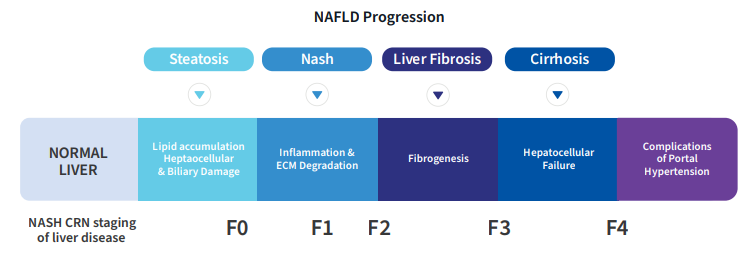
Histology is important in the evaluation of NAFLD. There have been three scoring systems for NAFLD in recent years, with the most recent being a semiquantitative scoring system validated by the National Institutes of Health–sponsored Nonalcoholic Steatohepatitis Clinical Research Network (NASH CRN) in 2001. This system outlines the NAFLD activity score (NAS), a composite score of steatosis, lobular inflammation, cytological ballooning, and fibrosis (disease stage).
 

NASH CRN Scoring System: NAS and Fibrosis Score
 

Steatosis GradeFibrosis Score
DegreeDescription (%)0None
0<51aMild (delicate) zone 3 perisinusoidal fibrosis
15-331bModerate (dense) zone 3 perisinusoidal fibrosis
234-661cPortal/periportal fibrosis only
3>662Zone 3 perisinusoidal fibrosis with portal/periportal fibrosis
 3Bridging Fibrosis
 4Cirrhosis


NAFLD Progrssion chart. Step 1: Normal Liver; Step 2: Steatosis, lipid accumulation heptaocellular & biliary damage (F0); Step 3: NASH,  Inflammation & ECM Degradation  (F1); Step 4: Liver fibrosis, Fibrogenesis (F3); Step 5: Cirrhosis, Hepatocellular  failure (F4); Step 6: complications of portal hypertension

*MASH Clinical Research Network (CRN) Scoring System

MASLD/MASH Research from Labcorp

Looking for research on MASLD and MASH? Review the scientific papers and presentations about MASLD and MASH that Labcorp has played a role in developing:

Non-alcoholic fatty liver disease and risk of incident type 2 diabetes: Role of circulating branched-chain amino acids

A pathophysiologic approach combining genetics and insulin resistance to predict the severity of nonalcoholic fatty liver disease

Rosuvastatin improves the FGF19 analogue NGM282-associated lipid changes in patients with non-alcoholic steatohepatitis

Differential regulation of microRNAs in nonalcoholic fatty liver disease

More MASH Research from Labcorp

Labcorp Drug Development is the industry thought leader in MASH drug development. Its MASH Education Center provides additional MASH resources, including webinars, case studies and scientific articles related to MASH.

What patients should know about MASH

Many people have probably never heard of MASH. Learn about its origins, the terms to know, and how MASH relates to other lifestyle factors.

Diverse group of people, portrait of a Caucasian man standing in front of his colleagues in modern office.

metabolic dysfunction-associated steatohepatitis (MASH) Information for patients

What is MASH? MASH is a form of fatty liver disease. According to researchers, one in four people is affected by fatty liver disease, which can develop for a number of reasons. There is good news, though. The effects of MASH can be reversible, mainly through lifestyle modifications. Changes such as eating healthier, increasing activity, and losing weight can improve or even reverse the effects of MASH. Knowing your risk is the first step to taking control of the disease.

How does MASH develop?

One of the primary functions of the liver is to process fat; whether breaking down carbohydrates and proteins for use by the body, or synthesizing other fats, like cholesterol, either for use in the body or removal (think: bathroom).

But the liver isn’t meant to store fat. When there is too much buildup of fat in the liver (more than 5%), this is called steatosis. As a means to protect the liver, inflammation and scarring (or fibrosis) starts to occur, and can negatively impact the liver’s primary jobs if it continues to progress without intervention, mainly through lifestyle changes.

When this happens in someone who is not a heavy drinker, it is referred to as Non-Alcoholic Steatohepatitis, or MASH.

Labcorp OnDemand

Purchase the same tests trusted by doctors, directly from Labcorp.

What are the stages of MASH, and how serious are the risks?

If left unchecked, MASH can be deadly. In essence, there are three main stages of MASH:

stage 1

Mild

Fat in the liver exceeds 5% (steatosis), inflammation occurs, and the liver is bigger than normal. Typically in stage 1, the liver will continue to function as it normally would, but may be compromised. This is also referred to as Compensated Cirrhosis, or MASH without Fibrosis.

stage 2

Moderate

In addition to stage 1 characteristics, scarring (fibrosis) begins to appear. Fibrosis can be classified as F1 through F4; Stage 2 of MASH involves fibrosis from F1 to F3. When a patient reaches this stage, the liver begins to deteriorate into liver failure. This is also referred to as MASH with Fibrosis.

stage 3

Severe

The most severe stage of MASH, the disease deteriorates into full-on cirrhosis or liver cancer. When this happens, the only option left is a liver transplant.

There are additional risks involved with a MASH diagnosis. The liver is at the center of the body’s metabolic processes, balancing out the body’s good and bad cholesterol – HDL and LDL, respectively. Damage to the liver as a result of MASH can release molecules into the bloodstream that can be harmful for the cardiovascular system.

MASH Symptoms and Warning Signs: What to Look For

MASH symptoms might not be immediately visible to people in the early stages of the disease. Most people who have MASH feel fine and probably don’t know they have it. As the disease progresses, however, and liver damage gets worse, they may start to see a worsening of symptoms, including:

  • Extreme tiredness

  • Unexplained weight loss

  • General weakness

  • Aching in the upper right part of the abdomen

It may take many years for MASH to become severe enough to cause symptoms.
 

Diagnosing MASH

No single test can diagnose MASH. Your doctor will ask you about other health problems you've had. To see if fat is building up in your liver and to rule out other diseases, your doctor may do tests such as:

  • Biopsy    

  • Blood tests

  • An abdominal ultrasound

  • A CT scan

  • An MRI scan

In some instances, a physician might request a liver biopsy to help diagnose MASH.

How lifestyle plays a role in MASH

Typically, most people who develop MASH are between 40 and 50 years old, and have one or more health concerns. On the other hand, it is possible for individuals with none of these risk factors to develop MASH.

There is no consensus as to why some patients develop MASH and others do not. While environmental factors and family genetic history are potential causes that could trigger the disease, there are still a lot of unknowns.

What science does agree on are the factors that can put people at risk for MASH and liver damage:

  • Obesity

  • Insulin resistance and type 2 diabetes 

  • High cholesterol and high triglycerides

  • Metabolic syndrome

The best course of action is managing the conditions that can increase an individual’s risk for MASH, or exacerbate the disease. This includes:

  • Reducing total cholesterol levels

  • Maintaining a healthy weight. Some research has suggested that reducing as little as 3-10% of your total body weight can make a difference

  • Control diabetes

  • Stop or cut back on drinking alcohol

  • Exercise regularly

Type 2 Diabetes and MASH

Type 2 diabetes influences the relationship between MASLD/MASH and cardiovascular disease. According to research, MASLD was found in 50% of patients with type 2 diabetes who had an otherwise healthy liver. In addition, MASLD/MASH-related cardiovascular issues are nearly twice as likely in individuals with type 2 diabetes.

MASLD/MASH and type 2 diabetes share many of the same risk factors: inactivity, obesity, genetics and environmental factors all add to the occurrence of these diseases. In addition, people with type 2 diabetes are at greater risk of advanced fibrosis, which is a major indicator of MASH.

While serious, the good news is that the same measures to help prevent and treat type 2 diabetes – eating healthier, exercise, weight management – can improve MASLD and MASH prognosis.

Man running in a street with headphones in ear

MASH definitions to know

  • Biopsy: a procedure where a sample of tissue is taken from the body to perform further diagnostic testing. In the case of MASH, that tissue is taken from a patient’s liver.

  • Cirrhosis: Also known as liver cirrhosis or hepatic cirrhosis, cirrhosis is a condition where the liver does not function properly due to long-term damage, typically characterized by the replacement of normal liver tissue by scar tissue.

  • Fatty liver disease: Fatty liver disease is a condition where excess fat builds up in the liver. Often there are no or few symptoms. There are two types of fatty liver disease: non-alcoholic fatty liver disease (MAFLD) and alcoholic liver disease (ALD). MAFLD is made up of simple fatty liver and metabolic dysfunction-associated steatohepatitis (MASH). The primary risks for fatty liver disease include alcohol, type 2 diabetes, and obesity.

  • Fibrosis: Also known as fibrotic scarring, fibrosis is a thickening of connective tissue in the body. It can occur as the result of normal healing, or due to excess tissue deposits. In the case of MAFLD and MASH, fibrosis is the result of the latter, also known as scarring.

  • Liver: The liver is an organ located at the upper right area of your abdomen. While it performs hundreds of functions in the body, its main jobs are: controlling blood sugar levels; filtering all materials (including foods, medicines, and alcohol) in the body; and processing fat.

  • MAFLD: Metabolic dysfunction-associated liver disease, or MAFLD, is a collective term used to describe a group of conditions where there is an abnormal accumulation of fat in the liver in those who drink little to no alcohol.

  • MASH: MASH stands for metabolic dysfunction-associated steatohepatitis. It is a liver disease from the family of MAFLD (non-alcoholic fatty liver disease).

  • Steatohepatitis: A type of fatty liver disease characterized by inflammation of the liver with coexisting fat accumulation in liver. This can occur due to prolonged alcohol intake, or other causes – in which case the disease is classified as ASH.

  • Steatosis: Also called fatty change, steatosis is abnormal retention of fat within a cell or organ. Steatosis most often affects the liver, where the condition is commonly referred to as fatty liver disease.

Frequently asked questions