
Image
22 Jul 2025
Author: Laura Huning, PhD, Staff Scientist, Companion Diagnostic Development
Gene therapy presents an alluring one-time curative solution to many genetic disorders. Over 4,000 gene, cell, and RNA therapies underwent development in 2024,1 and the pipeline of gene therapy products continues to gain momentum with novel technological advances in the field. For years, gene therapy developers have sought to improve therapeutic safety and efficacy by targeting and delivering to specific cell types. Adeno-associated viral (AAV) vectors are delivery vehicles that can bypass cellular defenses and transport therapeutic cargo to a variety of target tissues with moderate specificity.
The mild safety profile, wide tissue tropism, and minimal genome integration make AAV the most popular gene delivery mechanism employed in clinical trials by drug developers.2 Still, risk management remains an important consideration for AAV-based gene therapies.
AAV gene therapy has the potential to elicit a strong immune response due to a naturally occurring, immunological memory of the virus. In patients, AAV can trigger both the innate and adaptive arms of immune response with severity depending on factors such as dose, serotype, and route of administration of the therapeutic.3 Furthermore, there is a reduction in efficacy of cell and gene therapies associated with neutralization, sequestration, or other complement-driven anti-viral mechanisms triggered by preexisting antibodies.2 Because serious adverse events can occur due to an adaptive immune response to antigens present on the AAV capsid,4 screening assays that detect preexisting antibodies can be powerful tools for predicting therapeutic safety. It is estimated that about 30%-60% of the population has measurable antibodies to different AAV serotypes.5 These antibodies can potentially inhibit the transduction of target cells by rAAV vectors, thus impeding successful gene transfer, and may have potential safety consequences. Hence, evaluating anti-AAV antibodies is considered essential before the administration of systemic rAAV gene therapies.
To identify patients who may be at risk when administered a gene therapy, many sponsors of cell and gene therapy trials implement anti-AAV diagnostics to classify patients prior to enrollment in clinical trials. Total antibody binding assays (TAbs) are a simple affinity-based method, inclusive of all bivalent neutralizing and non-neutralizing antibodies binding to the AAV capsid, to determine preexisting antibodies to AAV. TAb assays have been approved through regulatory bodies such as the U.S. FDA for companion diagnostic (CDx) patient exclusion/inclusion criteria in gene therapy trials.
Labcorp offers development of total antibody detection assays through a dedicated CDx regulatory team that works closely with quality and development teams to maintain compliance with applicable laws and regulations and meet customer needs for development of medical devices. Labcorp’s stage-gated product development process is compliant with 21 CFR 820 and ISO 13485. This enables a streamlined entry into the clinic and supports diagnostic needs from preclinical to commercialization.
Bridging methodology for total antibody detection assay
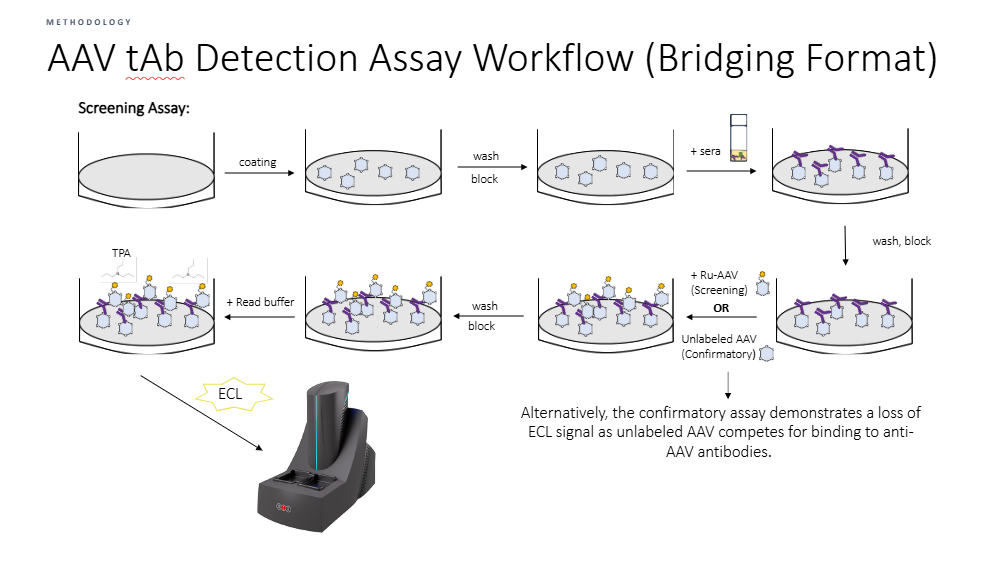
To meet these CDx needs, Labcorp has developed a TAb assay to detect AAV antibodies (Figure 1). By using a sequential bridging format on the Meso Scale Discovery Electrochemiluminescence platform, this new assay allows for increased sensitivity and a larger dynamic range over traditional ELISA methodology. The assay was characterized using a panel of five healthy adult serum samples, prescreened for varying levels of anti-AAV9 positivity. Contrived low and high monoclonal antibody controls were included in each plate for further assay characterization and monitoring of TAb performance. Screening and confirmatory tests for healthy adult sera were evaluated for six days. Distinct populations of the five adult anti-AAV9 inter-plate screening values for the panel of five adult anti-AAV9 negative and positive serum are shown in Figure 3. All screening precision values were at or below 20% CV, a percent variation accepted in method validation by regulatory authorities (Table 1).
| Serum Sample | Repeatability | Between Day | Total |
|---|---|---|---|
| Negative | 7% | 5% | 8% |
| Borderline | 6% | 7% | 9% |
| Moderate | 6% | 9% | 10% |
| Moderate | 6% | 12% | 12% |
| High | 7% | 11% | 12% |
Table 1. Precision of screening values
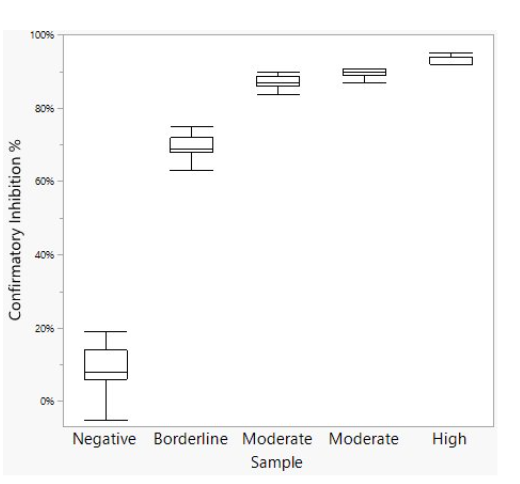
Figure 3.
Confirmatory inhibition values for human sera
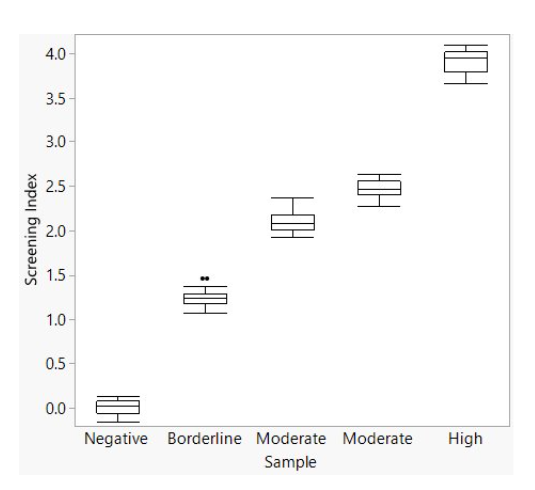
Figure 2.
Screening values for five sera of varying levels of anti-AAV9 antibodies
Screening and confirmatory tests for healthy adult sera were evaluated for six days across six plates, n=36 measurements per sample (Figure 2). Each plate contained six replicates of both screening and confirmatory measurements in parallel. The screening value, representative of antibodies that bind to AAV, is measured by dividing the average relative light units (RLU) for sample wells by the mean of a plate-specific negative control RLU and then subsequently log-transformed. Coating reagent: AAV9 empty wild-type capsid; detection reagent:- sulfo-tagged capsid, prepared in-house with MSD GOLD Sulfo-Tag NHS ester for labeling with ruthenium. Samples were added at a minimum required dilution of 1:30 due to high sensitivity and low matrix effects observed under these conditions.
| Serum Sample | Repeatability | Between Day | Total |
|---|---|---|---|
| Negative | 7% | 5% | 8% |
| Borderline | 6% | 7% | 9% |
| Moderate | 6% | 9% | 10% |
| Moderate | 6% | 12% | 12% |
| High | 7% | 11% | 12% |
Table 1. Precision of screening values
Here, we present a TAb assay for measuring anti-AAV9 antibodies using a sequential bridging assay on the MSD platform. The high anti-AAV signal-to-noise ratios and broad dynamic range correlate strongly with the majority of clinical anti-AAV antibody responses, making this assay a useful tool to guide patient selection, dosing strategies, and mitigation approaches when developing a cell or gene therapy.
Understanding AAV immunogenicity will be essential for preventing adverse clinical outcomes and optimizing the success of future therapies. As the field continues to evolve, integrating these tools into clinical workflows will be pivotal for advancing personalized, safe, and effective treatments.
Labcorp brings comprehensive capabilities for custom diagnostic development across platforms, supporting applications in cell and gene therapy, oncology, immunology, and beyond. Our integrated regulatory expertise ensures seamless pathway development from preclinical through commercialization, enabling sponsors to navigate complex regulatory requirements while delivering precision medicine solutions to support the success of therapeutic product.